
Wave Points
Designing a new loyalty currency from scratch
Company
SQUID Loyalty
Role
Senior Product Designer
Timeline
2025 – 2026
Overview
SQUID loyalty is Ireland’s no. 1 digital loyalty app with over 200k monthly active users. Offering digital stamp cards via an NFC tag in local businesses like cafes, restaurants and salons, it’s a system so deceptively simple that it had beaten out much larger and more dominant loyalty products from the sector for its beloved one-tap loyalty system that customers had grown to adore over its five years in the market.
I joined SQUID in early 2025 at a pivotal time in their product development journey. They had just secured €1m via a crowdfunding investment campaign and were ready to tackle the next phase of loyalty, the creation of their own loyalty currency, Wave Points.
Phase 1 / Pulling it all together
Having joined at such a crucial moment meant getting up to speed quickly with a mountain of documentation, ideas, sketches and disparate ideas. The team at SQUID knew roughly what Wave Points should be, having already locked in some of the tech stack necessary to get the project off the ground.
In terms of a tangible product though, or the nitty gritty of how it could work, things were still hazy. We needed to get cracking on clarifying the user problem, putting shape to sketches and wireframes and getting a quick feedback loop in place before we could start any kind of build.
Forming the idea
I set to work via a series of stakeholder meetings, catch-ups and workshops, to understand what Wave Points could look like, how it would interact with their existing core offering, while simultaneously familiarising myself with the world of loyalty/stamp cards and picking apart the habit-loop of what already made SQUID so sticky with their existing user base. A thorough competitive analysis informed the initial lo and mid-fi sketches in terms of the flow logic and drawing from familiar patterns within the sector where possible.
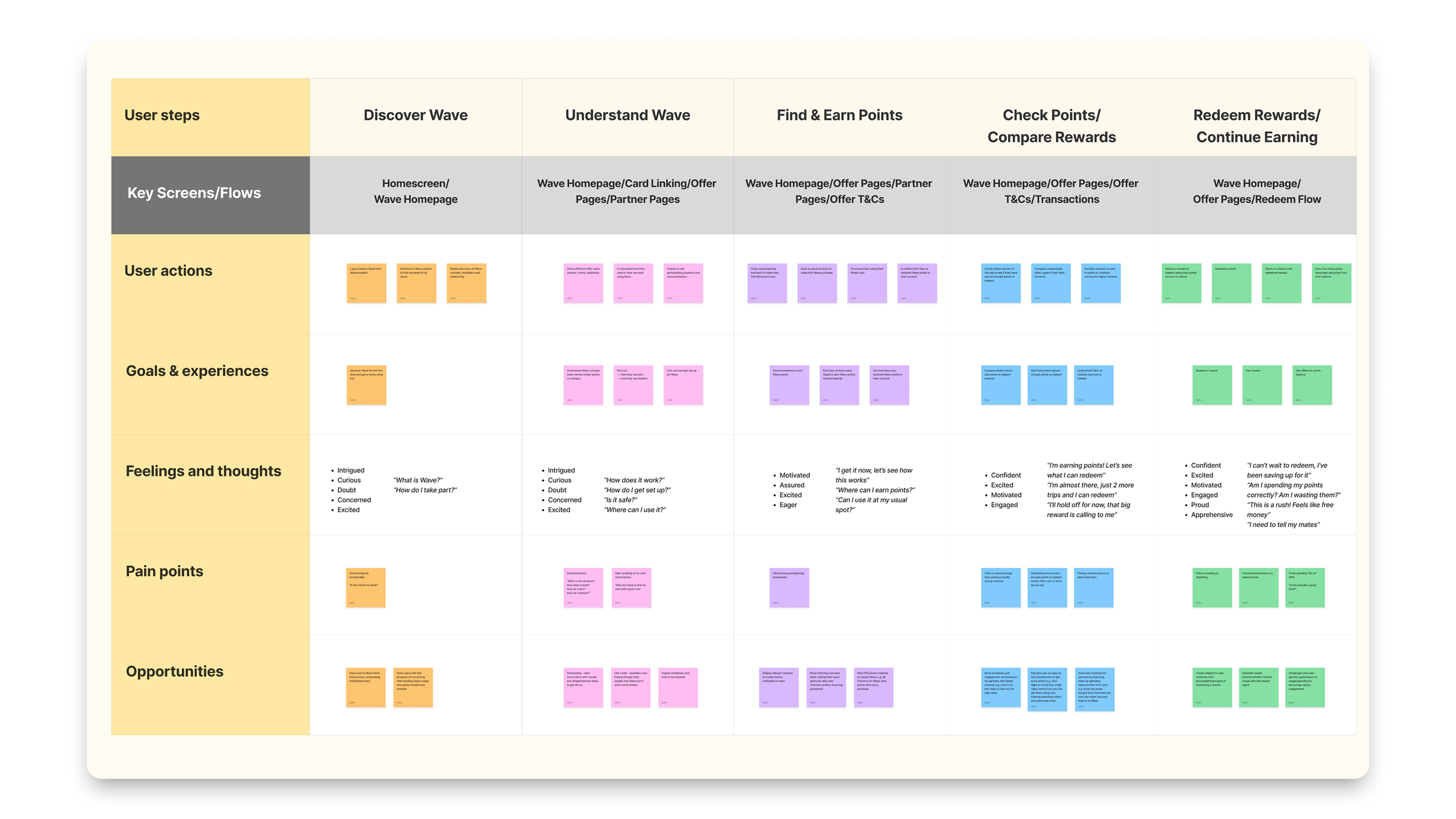
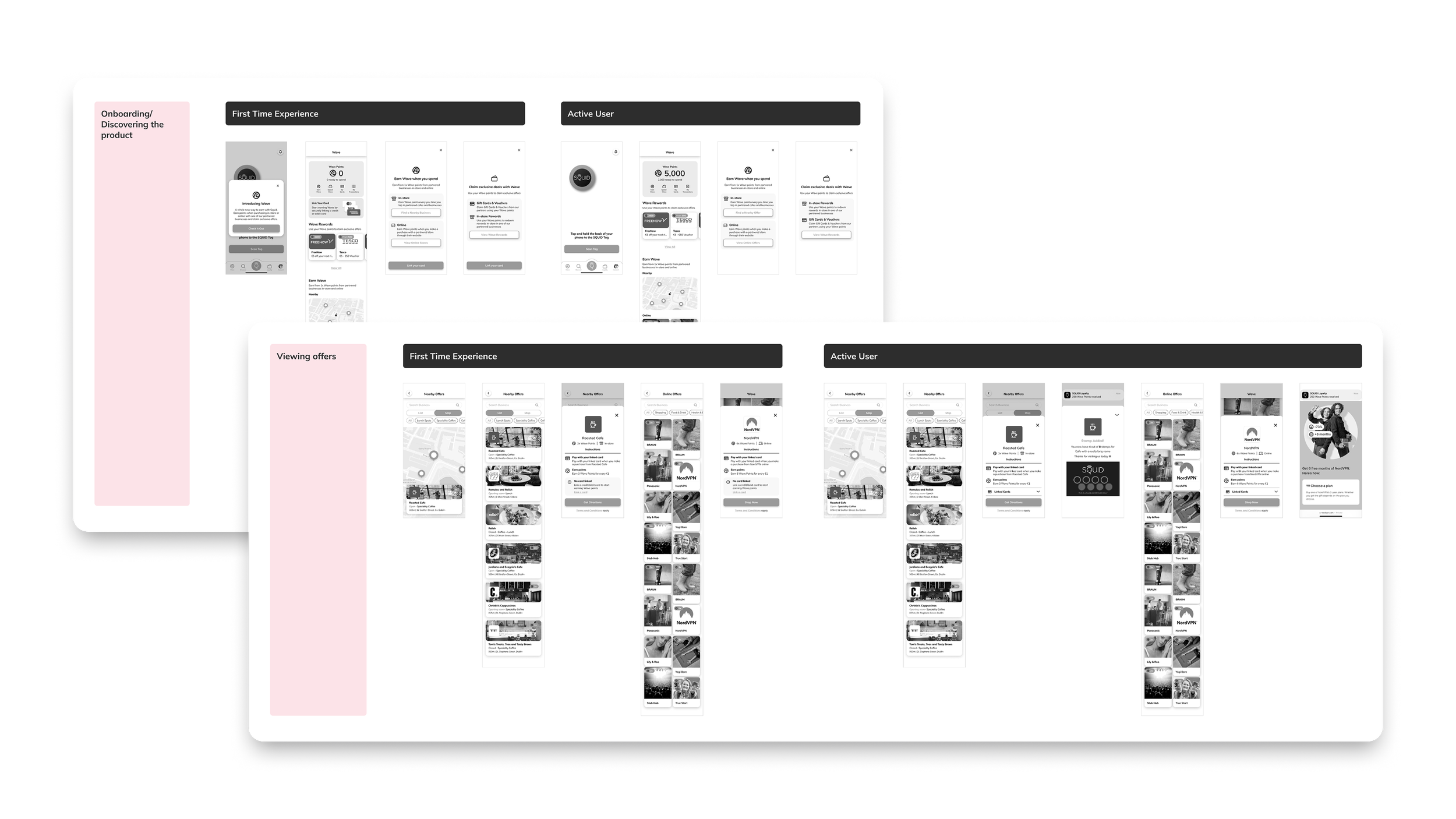
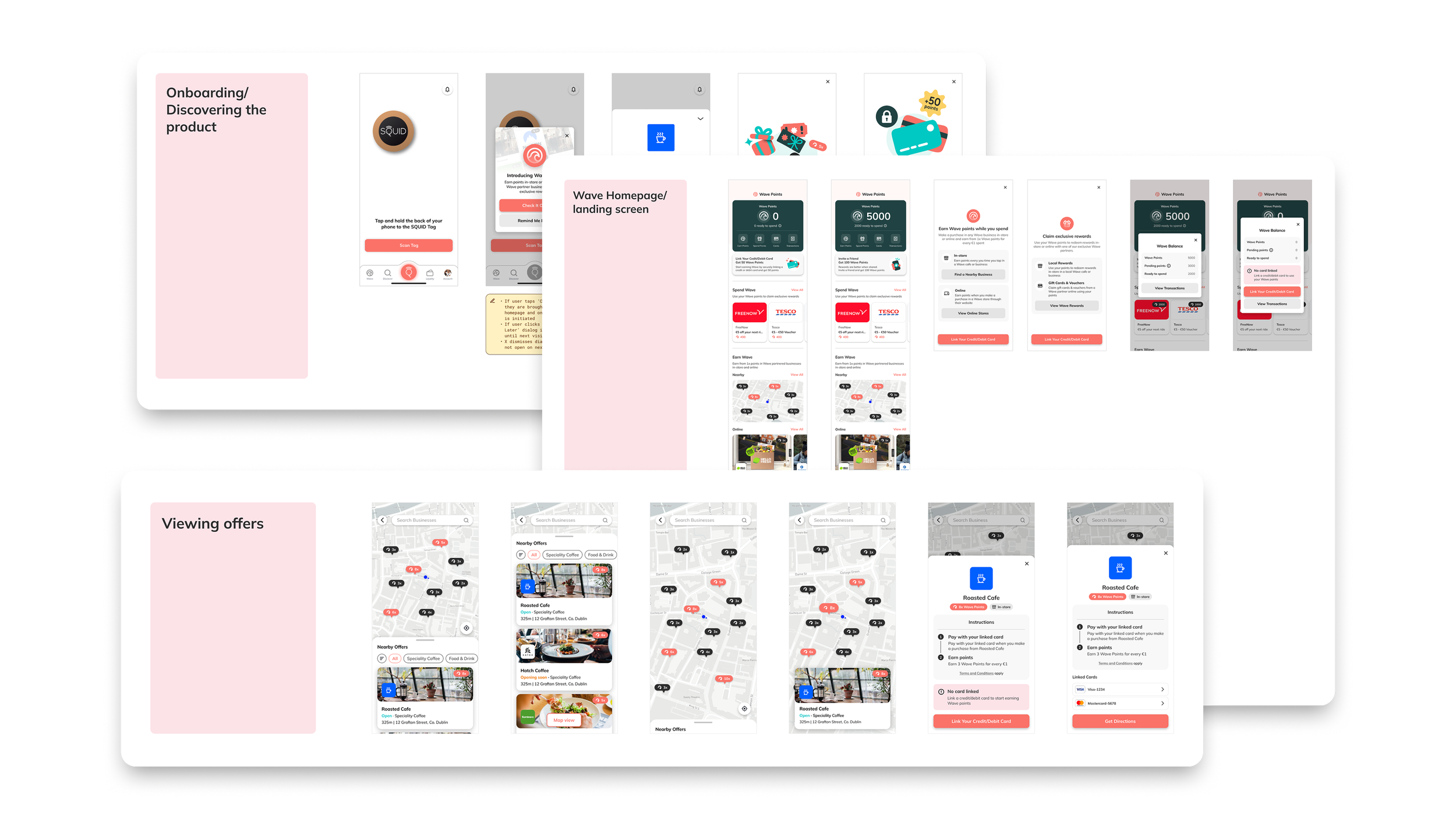
Initial Customer Journey Map, Key Flow Wireframes & Mid Fidelity Sketches
RITE testing / Getting fast feedback
While the team worked on technical feasibility in the background, I set about our first usability tests with the V1 sketches and prototypes. I wanted to test first impressions, information architecture and catch any glaring pitfalls within the key flows, recruiting existing SQUID customers to get a sense of how they would understand this new points currency in parallel with their existing loyalty stamp experience.
We tested key flows such as initial onboarding, browsing offers & rewards, linking a payment card and redeeming points for a reward in batches of 3-5 users so we could quickly iterate and re-test any snags we found in the prototypes and get them in front of another batch of users.
Based on these tests some key issues/trends began to emerge:
Key Issue #1
‘Cards’ being confused for loyalty cards instead of credit or debit cards
Result
3/5 participants confused the imagery and language around ‘’ with their SQUID loyalty cards and assumed they had to link their account to Wave instead of linking a credit/debit card
Recommendation
Update any reference to card linking to include ‘credit/debit’ card and make the icons/imagery more explicitly like a credit/debit card to ensure users understand this is separate from the loyatly schemes and note related to their ‘SQUID’ loyalty cards.
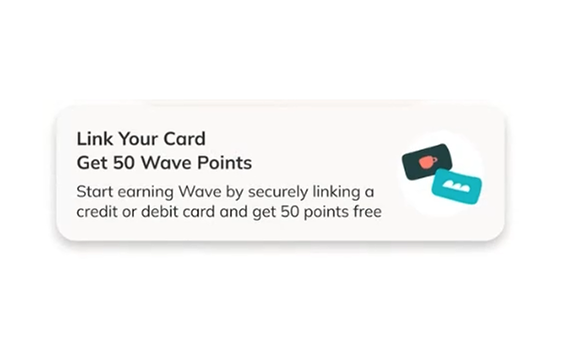
Yeah, I'm guessing that's my Squid card, but is it my actual, like my Revolut card? That's kind of confusing.
— Test Participant
Key Issue #2
Users didn’t understand that Wave businesses differ from traditional loyalty scheme businesses
Result
4/5 participants misunderstood that Wave partner businesses would be the same as existing loyalty businesses and vice versa, not that there was a difference between them
Recommendation
Update the term ‘partner/partnered business’ to ‘business offering Wave Points’ or ‘business where you can redeem your points’, though this is expected to be a broader product issue to be tackled at a later stage.
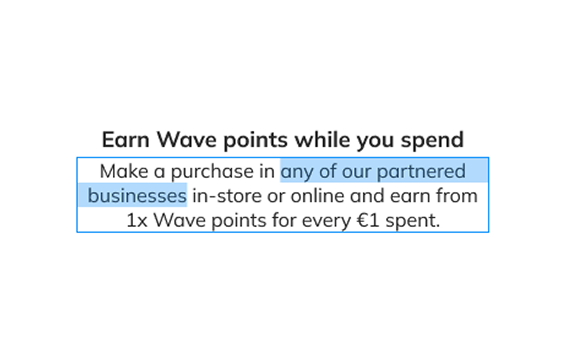
I assume that if it's a business that I've never seen SQUID in, that they just wouldn't be doing the wave thing.
— Test Participant
Key Issue #3
Insufficient visual difference between the cost of rewards and offer multipliers
Result
3/5 participants could not distinguish between the cost of a reward and the amount of points being offered for certain purchases.
Recommendation
Explore different visual treatments for the cost of a reward vs the amount of points being offered in a given business.
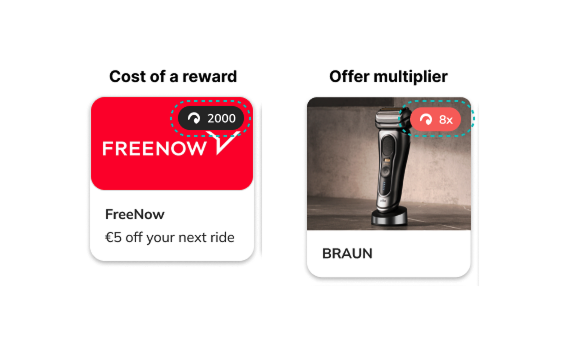
Does it mean that if you use the 5 Euro voucher, you'll get another 2000 points or something?
— Test Participant
Emerging Trends
Some emerging trends that came from our testing that we agreed to keep an eye on going into the beta were:

Emerging Trend #1
Customers will most likely be discovering this at the point of sale
8/10 participants across tests flagged that, for the most part, the only time they open their squid app is at the point of purchase when tapping.
Recommendation
A seamless onboarding flow for users within the limited, moment-based window of interaction (when paying for a coffee etc) will be critical for getting users introduced to the feature.

Emerging Trend #2
Customers want tailored/relevant rewards
With 6/10 participants, the rewards page had the strongest response both positively and negatively. The relevance of the rewards to them were a deciding factor in whether they would be motivated to go out, earn and invest effort in the product.
Recommendation
Research different methods and approaches for surfacing relevant rewards (based on demographic, location and consumer behaviour)
Phase 2 / Alpha Test
Next up, the alpha test, where we planned on releasing Wave Points to a select cohort of high activity locations across central Dublin, and recruit users for a mixed methods study to catch any technical issues and UX snags. Over the course of a 30-day period we enabled Wave Points for users who had been active in this area to measure the adoption and engagement and get early feedback on the appetite for the product.
Closed alpha test carried out across Dublin central
Key Results & Metrics
Sample Size
45
Usability Rating
4.1/5
Card Linking Rate
93%
Earning Rate
75%
Our alpha test was a technical success. Users successfully completed all the key tasks we had set them as part of the criteria for taking part. They had linked their payment cards and repeatedly earned points in business, reporting back on their impressions, experience and difficulties which we took away to begin iterating and testing on as we started the rollout to more users.
Key Trends
Comprehension - Moving from stamp cards to a loyalty currency was confusing for users accustomed to their existing one-tap stamp flow. Understanding how to earn, where to earn and how to redeem their points wasn’t clear enough and needed work to hit home.
Coverage - Users didn’t have enough coverage to earn points, despite actively earning stamps already in the area, many users reported needing more locations closer to their home base or across the city for the system to work for them, not for them to work for the system.
Perceived Effort/Value - stamp cards are easy, buy 8 get 1 free. Wave Points take longer to earn and the perceived effort on the user end wasn’t worth it, we’d need to work on making it feel more worthwhile, and that the effort to get to a reward was ultimately worth their time.
Phase 3 / Moving to Beta
Coming out of beta we were happy that everything was technically sound for the most part. Users could link a payment card, make transactions and earn points. We even gave them enough of a welcome bonus that meant most were within a comfortable threshold to reach a redemption within a 30-day period to ensure we could test the entire user journey, from first earning interaction through to claiming a reward and creating a habit loop.

The velocity issue
One thing we hadn’t anticipated was how long it would take the average user to get to redemption and to find value.
From the start we assumed we could just leverage existing user habit loops (i.e. grabbing coffee in their favourite spot) to earn points.
The issue was that points accumulated from coffee spend was nowhere near fast enough for this to feel like a valuable investment of time, attention or energy.
We needed to think fast and come up with a way for them to supercharge their points while still framing it within a familiar behaviour.

Vouchers to the rescue
It was suggested that we could leverage the tech stack used to let customers trade their points for rewards, and reverse-engineer it in a way that would allow them to get to redemption faster.
We now had the option to give users the option to buy vouchers for familiar, habitual-spend brands (think your local supermarket run, or online brands like takeaways, gig tickets, or holiday bookings) which would result in much higher transaction amounts, and as a result boost customers’ points velocity.
The main catch being a huge bet on whether users would adopt a pre-purchase flow into their weekly spend in the name of earning points.
After some initial rapid usability testing to stress test the new in-app purchase flow, we quickly launched our prepaid voucher feature and adopted a more specific onboarding, reframing Wave Points as a weekly spend mechanism based around voucher purchases, retargeting a core section of our existing user base and measuring uptake and adoption.
Purchasing prepaid vouchers to earn Wave Points
Targeted prepaid voucher onboarding
Phase 4 / Fine-tuning the Customer Journey
Voucher earning was a hit, albeit with an initially modest group of users, but with a really healthy retention rate by month 2 (approx 60%). The average points velocity per user more than tripled in less than 3 months bringing users to a much faster rate of getting to a redemption and ultimately locking them into a habit-loop of earning and redeeming
The next step was to focus on user acquisition at the top of the funnel, and draw users who had passively engaged with Wave Points to date and get them back in and understand the value.
We experimented with a series of educational videos from the home screen, in context tutorials and guides and by framing the purchase flow around the core value proposition that we knew would hit home with our loyal stamp users, how close their voucher purchase would being them to the price of a free coffee.
Over the course of a 3 month period, through a combination of onboarding and lifecycle marketing experiments, first time voucher purchasers doubled month on month, bringing more valuable earners through the top of the funnel and starting them on their Wave Points journey.
Key screens - Landing screen, earning & redemption collections
Earning collection screens
Earning offer detail popups
Redemption flow